Be yourself; Everyone else is already taken.
— Oscar Wilde.
This is the first post on my new blog. I’m just getting this new blog going, so stay tuned for more. Subscribe below to get notified when I post new updates.
Be yourself; Everyone else is already taken.
— Oscar Wilde.
This is the first post on my new blog. I’m just getting this new blog going, so stay tuned for more. Subscribe below to get notified when I post new updates.
I recently listened to the podcast of “God Acting Womanish” by Dr. Karen Ross and I learned a lot about feminist theology and different aspects of what people think is true or not true in the Bible. When watching and listening to this podcast, in the second half, Dr. Ross focused on who God is to people.
Dr. Ross focuses on what the feminist theologians know about God and the main aspect of this was that God is spirit. God is beyond being human and that God is neither male or female, but can have certain qualities that are respective to those likenesses.
I really enjoyed listening to this podcast because it gave me the opportunity to learn more about a different viewpoint on which I might not have focused on my own. The feminist belief is completely different than my own and has given me something to consider. It’s also a newer concept in theology and in other people’s beliefs which could make people question if they could and would change their views.
At the end of the podcast, Dr. Ross poses a question asking if we would change the way we talk about God depending on what we believe. The funny thing is for me is that while writing this I continued to think about God as He. To be honest, I’m not completely sure if I will change my beliefs on what to call God, but it did raise some serious questions. One being that God can be like a woman or man but that he cannot be one literally without being reduced to a human.
I believe that this was a great topic to listen to because it did bring up some questions and beliefs that I would not have thought about before. I’m also glad that I have thought about these beliefs and will continue to do so.
The Way was an amazing movie where we got to see the journey of four vastly different people including the main character, Tom. At the beginning of the movie, Tom finds out that his son, Daniel, had died in France at the beginning of the Camino de Santiago in a storm. We can see what Tom’s life is like without faith or belief in God soon after learning of his son’s death and then towards the beginning of his walk. Tom is not a religious man and even says so himself that he only celebrates the big holidays of Christmas and Easter. When watching this movie, most people would be able to tell that he does not want to talk about what happened and he does not want to open up about anything and that he does not believe the walk will change anything about himself.
At the beginning of the movie when Tom starts to leave for the Camino after obtaining his son’s ashes, the police captain asked him why he was walking the Camino. Tom answered that he was walking for his son, to which the Captain replied that he should only walk for himself. I do believe that Tom was originally walking for his son, Daniel, so as to help him finish what he started, however, as the movie continues, one can tell that he is starting to walk for himself as well. He is starting to believe again through the people he is walking with, through the places he is walking from and knowing what he is walking to at the end.
“Ignatian spirituality considers everything an important element of your life” (Fr. Jim Martin). In Ignatian spirituality there are many different paths to God that one can encounter throughout their life in any way. I believe that Tom starts off with the Path of Disbelief. He no longer believes in God and even says what was the point of praying after his son was already dead. He continues in this path throughout a good portion of the movie before he starts to encounter another Path. I believe that throughout his journey, he is slowly starting to edge away from the disbelief and moving towards the Path of Exploration. Tom is searching for something and he is growing as a person. At the beginning of the movie, Tom says that being a dentist and staying where he was, was the life he chose. Daniel told him that he needs to live his life and I believe that throughout the Camino, Tom started to realize that as well. That he needed to live his life to find his meaning and to restore his faith in God. Tom then makes it to the Path of Belief at the end of the movie when he makes it Santiago de Compostela. Although Tom started off with walking for Daniel, he had a lot of spiritual growth throughout his travels, which I believe is a reason why he then continues to travel after finishing the Camino. He now believes in God again and now has more faith to continue in other aspects of his life. Tom faced many challenges throughout the movie which I believe helped him in moving towards the renewal of his faith and into the Path of Belief.
I really enjoyed this movie and seeing the different Paths that Tom had to encounter. Mostly through the way that he acted and the way that he changed from the beginning to the end of the movie. He went from being, what seemed, very depressed and heartbroken about his son to learning what his son meant about living his life and finding the meaning of it as well.
The Path of Belief
I think that this song goes along with the idea of always having faith and belief in God. As Father Jim Martin says, the person’s belief has always been with them and I feel like that fits perfectly with the song in the aspect of it always being with you and “standing by you”. It also makes me think of a persons belief, depending on the person, always being there at any given moment and that is what the song is also talking about. That at any moment, good or bad, someone will be with you.
The Path of Independence
“Here I Go Again” by Whitesnake
I believe that this song fits into the Path of Independence because of the idea of looking for something but not being able to find it, at least not right away. As Fr. Martin explains, some people leave the church because of a difference or change in beliefs while others are still firm believers. But, they’re all looking for something which I think fits with the song on the basis of looking for something even though you might not be positive what it is, how you’ll find it, or if you’ll ever find it, but that people still continue to search.
The Path of Disbelief
“Only the Good Die Young” by Billy Joel
I think that this song fits in well with the Path of Disbelief because of the idea of doing things that go against someone’s original thoughts or beliefs. In this song, the lyrics talk of pushing away from certain beliefs because of the lack of “fun” and that “the sinners are much more fun”. I think this is similar with the path because of Jim Martin’s idea that “organized religion holds no appeal” to some people.
The Path of Return
“More Than a Feeling” by Boston
I believe that this song fits into the Path of Return because as Fr. Jim Martin tells us of the path, it is about returning to God because of something that “reignites their curiosity”. The meaning of this song is similar because of the lyrics telling of hearing a certain song and automatically being brought back to this girl and the time they had together. Although, in the song, he can’t get the girl back, whenever he hears this song, he automatically thinks of her which I think relates to this path and the idea of being brought back to God by something in your life.
The Path of Exploration
“Into the Unknown” from Frozen 2
A much more different song compared to the others! 🙂 But I felt like it fit with the Path of Exploration and the idea of finding something new even if you’re not entirely sure what you’re looking for (similar to the Path of Independence). However, one of the main aspects that Jim Martin explained to us was the aspect of having to choose between what you grew up with and finding your own way, which I think is similar to the song and the fact that she has to choose whether she will go “into the unknown” or whether she will ignore it and stay where she is.
The Path of Confusion
“Carry on Wayward Son” by Kansas
I believe that this song goes along with the same ideas as the Path of Confusion especially in the aspects of not knowing which way to go and always being at odds with yourself. I belive that it matches with the path and that people “run hot and cold with their childhood faith – finding it relatively easy to believe in God at times, almost impossible at others”. I think that it also has other aspects that are the same in that your path can end in different ways, but in one way, “There will be peace when you are done”, when the person has made their decision regarding their faith.
Most Christians when looking at the cross think of hope and happiness because of what was gained from it through Jesus dying for our sins. James Cone, author of The Cross and The Lynching Tree, tries to explain this. In this essay, Cone discusses Jesus dying for us on the cross, but what he is trying to prove to us is that the cross has a different meaning than what we all believe. People tend to ignore the literal meaning of the cross and what it represents because of the darkness that surrounds it. Cone believes that those who want to understand the cross in America, must learn of and understand the lynching tree because “The cross and the lynching tree interpret each other”.
Jesus was dying to save the same people that were persecuting him in the first place. I believe this is one of the main reasons that Cone was connecting the cross and the lynching tree. The crowd at Jesus’ crucifixion was continuously shouting “Crucify him!” while the people in the crowds at lynchings were consistently screaming “Lynch him!”. They are one and the same because “The lynched black victim experienced the same fate as the crucified Christ”. With this knowledge, all Christians must look at the lynching tree and what was done there to fully understand the cross and the experiences that so many people had to go through.
However, the cross and the lynching tree are not usually connected and thus not discussed together. This is mostly due to the people seeing the cross as “…one of the most visible symbols of America’s Christian origin”. Jesus’ crucifixion and lynchings are not viewed as being similar because people try so hard to forget about the bad things that have happened in the world. People try to forget that lynchings have happened, and they try to forget the bad aspects of the crucifixion, but the bad is necessary to fully understand and have a serious conversation about who Jesus is and what Christianity means.
James Cone, through his essay, also discusses the Word of God being offensive. He examines the stories and the different meanings and specific wordings that can be taken and used for someone’s own ideas. Cone specifically says, “God’s word is not a popular word, not a successful word, and not an entertaining word”.
Cone’s arguments relate to Roberto S. Goizueta’s argument in From Calvary to Galilee about the denial of suffering and of the poor. Goizueta discusses people hiding and not acknowledging what we do not want to see, hear or talk about. There is a refusal to acknowledge what happened at the crucifixion. This is the basis for Jesus showing his disciples his wounds and makes them touch his wounds to convince them what really happened after his resurrection. When Jesus is resurrected, He still has his wounds because what happens during the crucifixion that is bodily must remain for after his resurrection. However, as Goizueta points out to us, although this is true, people do not want to acknowledge it and they do not want to understand it. These things are not in our control “so we surround ourselves with things that promise security and invulnerability”.
People do not want to acknowledge the details of the crucifixion and they do not want to admit what happened during lynchings. As Goizueta discusses, “In the end, what we fear most is not “those” persons but ourselves, our weak, fragile, vulnerable, wounded selves. So we avoid touching, or even seeing, the wounds. We avoid risking the act of solidarity, or companionship with the victims of history, not because we hate them but because we hate ourselves”.
As Cone points out, people do not understand the connection between the cross and the lynching tree – how they are one and the same. Even when people do see the connection, most try to ignore it as best as they can. The cross and the lynching tree can be seen as being connected to each other. For people to fully understand the cross, they must remember the pain and suffering that comes along with both the crucifixion and the lynchings.
Who do you say that I am? This question can be answered in many different ways by many different people and cultures. This answer has also changed over the time periods and places in which it was asked. For the Bantu people in sub-Saharan Africa, Jesus is known as “Christ our Ancestor”. For African women, Jesus is their savior and protector.
To the Bantu people in sub-Saharan Africa, Jesus is “Christ our Ancestor”. In this case, in being their Ancestor, Jesus was also known to be their Elder Brother who would be a model or example for them in how to lead their life to eventually become an Ancestor. For the Bantu, “… the eldest child is charged with responsibility for the acts of the younger [and] Christ has shown himself to be our eldest brother in taking responsibility for our wrongs…”. Christ is the male Ancestor and the Bantus are supposed to model their way of life based off of Jesus’ teachings and way of life.
I like the way of the Bantu culture believing Jesus as their Ancestor because of what he does for people. Especially in the way of mediating between the people and God. The people offer up to Christ for his help and protection, but also as a way to remember him and what he did for all people.
In the Bantu way of life, to become an Ancestor one must give life. However, this is not just biologically. Although that does matter, giving life can also come about by giving a person life in their spirituality. This is what Jesus did and when he came to give life, “…he gave it in abundance”. Jesus watched over everyone through the life he gave them as the Elder Brother, and so other Ancestors will watch over the next generations of family.
For African women, Jesus is more of a protector and savior. He helped the women with their struggles in gaining control of their lives as well as their struggle for bare necessities. In the villages, there was usually one woman at the center for all their religious and spiritual practices who was responsible for leading others to faith. This central figure led to the shaping of the African women’s experiences of Christ and how he enables them. Jesus, because of his belief in women, “… gave them their true worth and dignity”. Although not originally present in African culture, Jesus gave them the equality that they so deserved.
In the African church, there was a misinterpretation of women and their relation to God, but Jesus took them seriously and saw them as responsible women who knew what they needed and that they could act of their own accord. “In his teachings and relationships, Jesus recognized women as persons in their own right and disapproved of anything that discrimiated against women”. Because of this, African women saw Jesus as their protector, savior, mentor, and most importantly, closest friend.
There are similarities and differences in ideologies and answers to the question “Who am I?” depending on the time and place. African women saw this question and answered it as Jesus being someone who could help them and someone who believed in them no matter what. The Bantu saw this question and responded with the belief in Jesus as the Ancestor and as their mentor. These are both similar and different to the time of the disciples because at that time the answer would depend on their personal experiences with Jesus.
People can have their own answer on who Jesus is to them and to the Bantu, he is “Christ our Ancestor”, the Elder Brother, and an example to all. To African woman, he is a savior and friend. Now, I give this question for others to think about. Who do you think that Jesus is?
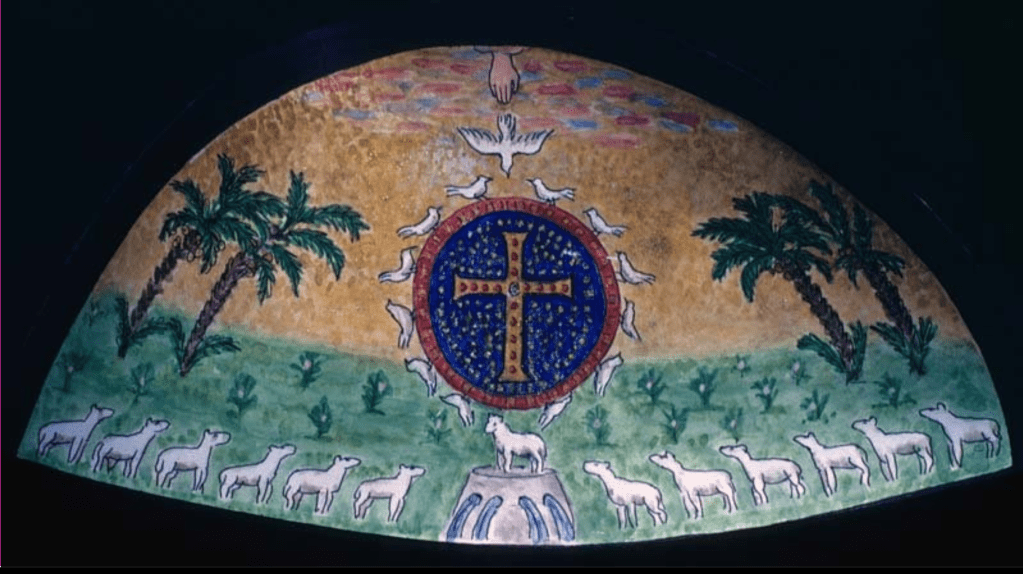
The image of the Holy Trinity that I chose to analyze is this artwork above from San Clemente, Rome. I found this one the most interesting because it is not just the generic Trinity of the old white man, the young white man, and the dove. Although there are the doves for the Holy Spirit, there are more differences for both “the Father” and “the Son” in the Trinity.
I believe that, in this image, the hand above the main dove, coming from the top of the artwork, is the hand of God. I then see the middle sheep on top of the pedestal with the cross above it as Jesus who is surrounded by his twelve disciples (the other twelve sheep). I chose this image because the imagery makes you think more than a traditional depiction of the Trinity. I also really liked how this depiction of the Trinity does show the twelve disciples as they are a part of Jesus and his story as well as Jesus being known as the Good Shepherd.
An important part of the image is the aspect of God’s hand reaching down towards both the Holy Spirit and Jesus which I believe helps symbolize the equality of the 3 persons in one God. This also helped me to think of Jesus as being both divine and human. Jesus is close to the ground near the other sheep, showing He is close to humanity in certain aspects, but as he is not fully on the ground like his disciples, he is also divine like God.
The representation of the Holy Spirit also connects to Jesus’ existence as both divine and human. Jesus’ ability to perform miracles on earth stems from the help of the Holy Spirit. I believe this to be the reason as to why there are also twelve doves surrounding the cross. I believe these twelve other doves to be representing the disciples and helping us understand how the disciples did their job in spreading the word of God. As many of the gospels say, the disciples were able to speak to many people from all over at the same time. These people were able to hear the Word of God in their native language through the help of the Holy Spirit in the disciples. That is why I believe that the top dove looking down towards Jesus is the Holy Spirit as a part of Him as well as the other twelve doves being a part of His twelve disciples.
When looking at many of the other paintings or images of the Trinity, although beautiful with deep meaning, they are often straightforward in their imagery. I thought this depiction was very interesting because of the differences in how “the Father”, “the Son”, and the Holy Spirit were represented.
St. Vincent de Paul was born in 1581 and grew up as a normal boy living in the countryside in France where his family had a house and owned land. When St. Vincent de Paul first became a priest, the reason why he did so was not because of his religion and spirituality but because of he viewed it as a job that he could earn money from. As a young adult who became a priest at the age of nineteen or twenty, his priority was to raise enough money so that he could go home to live with his family and retire. However, soon after beginning his priesthood, St. Vincent de Paul had a spiritual conversion through his experiences with the people and events that he encountered and took that as God speaking to him. Instead of asking God how to change, he took what he saw and started with that. After his conversion and taking what he saw as God’s word, his first sermon was on the necessity of giving a confession and then established the five virtues that would become the pillars of his missionary that began that day. Those five virtues were simplicity, humility, gentleness, mortification, and zeal. As he continued on in his journey as a priest, St. Vincent de Paul mainly focused on helping the poor and needy. With the formation of the Ladies and Daughters of Charity, as well as his friendship with Louise de Marillac, he was able to help the poor and provide for whoever needed the support. The documentary, Vincent de Paul: Charity’s Saint, is a great source of learning about what it means to be Vincentian.
To be Vincentian one must not just pray for those in need, but act on that need. For example, “Again and again, he urged his followers not just to act but also to pray, and not just to pray but also to act” (Maloney, 4). His followers must always act and pray to keep with spirituality and the values that St. Vincent described for us. Throughout the documentary, those five values can be described in a more contemporary way as being honest, reasonable, approachable, self-disciplined, and hard working. These were all values that St. Vincent himself followed and to be Vincentian one must follow these as well. One can also be Vincentian through “…the language of relationships: being with the poor, working with them, knowing and loving them as friends, brothers and sisters, forming a Vincentian Family…” (Maloney, 4). This is the act of physically helping and being with those that need the help which can be seen a lot through the description of the Daughter’s of Charity in the documentary. Physically being with those that need the help is something that we do as students at St. John’s through the Academic Service Learning Program, especially when signed up through Campus Ministry.
Another way that a person can be Vincentian is through the value and act of being genuine, the virtue of simplicity. This means always being truthful and “… practicing the truth through works of justice and charity” (Maloney, 5). This virtue can also be talked about through Madame de Gondi’s asking of “What must be done?”. When watching this documentary, one learns of the story St. Vincent and Madame de Gondi and their travels of the de Gondi’s land. Through their travels they learned of the people’s loss of faith, so when Madame de Gondi asks what must be done, she is asking what she and others can do to help. This is Madame de Gondi’s use of the virtue of simplicity – instead of an elaborate plan to restore the faith of the people, she sought guidance to ask what the people needed the most. Thus she was able to bring back the truth to the people who had lost faith.
Being Vincentian also applies to us as students at St. John’s as it is a Vincentian university. Through the Academic Service Learning, ASL, we are able to go to many different places to do service – some of those include volunteering at soup kitchens, midnight runs, or helping out at a shelter to help the poor and homeless. My personal experience has been with the Queen of Peace Residence Home, spending time with residents who wanted companionship. As St. John’s mission statement explains, “Wherever possible, we devote our intellectual and physical resources to search out the causes of poverty and social injustice and to encourage solutions which are adaptable, effective, and concrete”.
“So, the keystone in Vincentian spirituality is this: following Christ as Evangelizer and Servant of the Poor” (Maloney, 4). Through following Christ and in being a servant of the poor, one can be Vincentian through the real life actions and effects of St. Vincent’s virtues and that can be seen in multitudes at St. John’s.
“Vincent De Paul: Charity’s Saint.” YouTube, YouTube, http://www.youtube.com/.
Maloney, Robert P. “FIRE WITHIN: The Spirituality That Sparked the Works of St. Vincent De Paul .” 2017, learn-us-east-1-prod-fleet01-xythos.s3.us-east-1.amazonaws.com/5b000e5353fae/2491930?response-content-disposition=inline%3B%20filename%2A%3DUTF-8%27%27FIRE%2520WITHIN_%2520The%2520Spirituality%2520that%2520Sparked%2520the%2520Works%2520of%2520St.%2520Vincent%2520de%2520Paul%2520%25281%2529.pdf&response-content-type=application%2Fpdf&X-Amz-Algorithm=AWS4-HMAC-SHA256&X-Amz-Date=20200326T194555Z&X-Amz-SignedHeaders=host&X-Amz-Expires=21600&X-Amz-Credential=AKIAZH6WM4PLTYPZRQMY%2F20200326%2Fus-east-1%2Fs3%2Faws4_request&X-Amz-Signature=47e2b91863bd4b3dadf2f75ed95cb6a9611b21b1d2e27863e0efd6a99a3089ea.
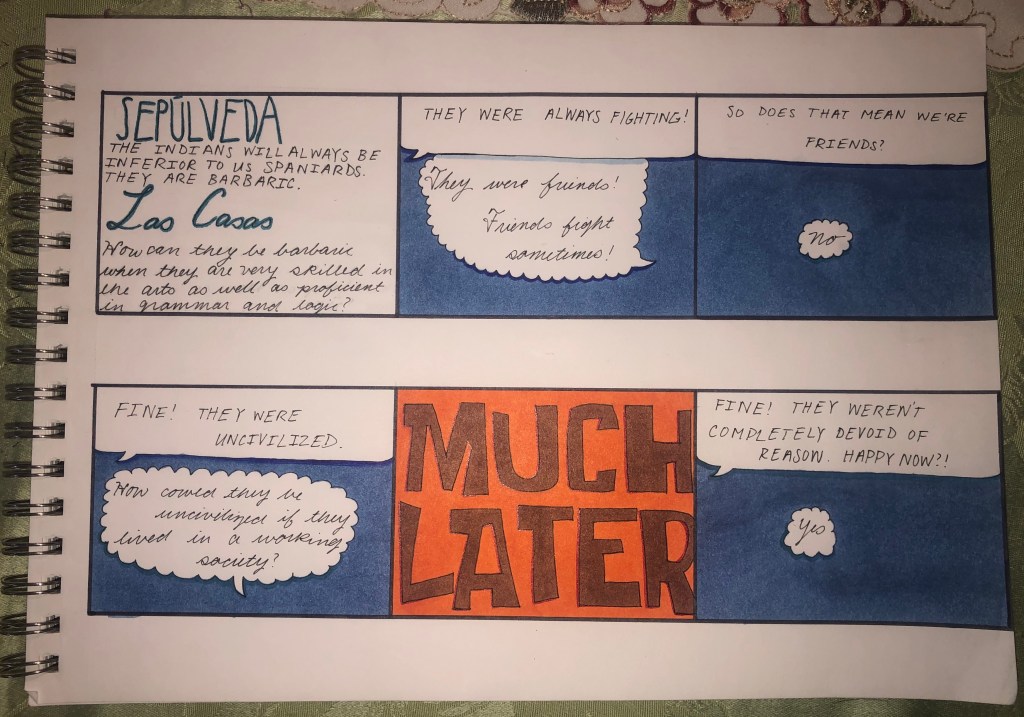
Martin Luther was so angry at the church because of his belief that the people shouldn’t pay the church for forgiveness of their sins. He believed that it was wrong that the Pope was raising money in this way and he then decided to write down his views on the church. There are known as the 95 Theses and he, after writing them, nailed the papers to the church door. I believe that Martin Luther was also not very happy because of the idea of the church being so rich while its parishioners were very poor. This also was a big deal to him because the parishioners still had to pay the church, in both the tithe and penance.
Martin Luther’s view on Christian Liberty is that he wanted justification for what the church was doing and that he wanted grace, faith, and scripture alone to justify what happened in the church. If the church couldn’t justify their decisions based off those three factors, then he believed that the church should have changed their ways. However, although the church was not able to justify their actions in this way, they excommunicate Martin Luther and the church was split into two, Catholicism and Protestantism.
I agree with Martin Luther in his views that the people should not have to pay for the forgiveness of their sins to get into Heaven. A church does need some money to run properly, but the amount of money that the church was taking from the parishioners was an absurd amount since these people were already poor enough.
Throughout watching The Monastery, I believe that we can learn many things from the principles that the monks follow. This includes key parts of monastic life. These key parts include having a greater silence, multiple services per day, being obedient, having humility, participating in manual work, being accepting of others and of yourself, and forgiving yourself and others. While some of these are harder to achieve and maintain than others, such as participating in multiple services each day, other aspects of this lifestyle are able to be brought into modern day life.
Some aspects of monastic living that can be used throughout modern times are silence, obedience, and humility. The aspect of silence can be seen through maintaining silence in certain parts of our day where you take that time to reflect on your life. For any person who commutes, time in the car or on the train can be spent in silence rather than listening to the radio or chatting with nearby passengers. This could provide time for reflecting on what you have done, what you can do, as well as learning something new to add to one’s life. Obedience can also be used throughout your daily living, such as in abstaining from counterproductive actions or in continuously pursuing the other aspects of monastic life. For example, being obedient when keeping up with the silence in your life. Humility for some might be harder to maintain because of one’s pride and happiness over what they were able to achieve, but, in the monastic way of living, one must always be humble and not constantly talk of what one has. These are some things that we should learn from the monks and take to use in our lives because of the outcomes and ultimately, happiness, that we can be granted in the long run.
I believe that the men, throughout their 40 day experience, did have some trouble, as you can see in the videos, but that at the end of the 40 days they were really able to take something away from it all. These five men were able to take an aspect of monastic living and incorporate it into their lives outside of the monastery. They were especially able to use the monk’s principles to learn to get past challenges in life, including learning to live with others in a harmonious fashion. This is so that they could leave behind their old, normal life to create a new normal. While at the beginning of this documentary, these rules may have been hard to follow or fully understand, the men went through the 40 days and began to uncover and grasp why it is that these monks keep with these ideals of living.

 Victoria’s Perspective on Christianity